Interview with Gillian Batcher- Jewel Envy turns 20!
Owner and Founder of jewel envy and pash jewellery design
Conducted by: Lindsay MacDonald
Published: 2026/11/10
In the Toronto Jewellery Community, if you were to make a list community builders, chances are Jewel Envy Founder, Gillian Batcher will be near the top of your list. At the risk of sounding cliché, Gillian truly does it all. Gillian owns and operates one of the most well equipped private studios in Canada, she creates her own line of Jewellery under the name Pash Jewellery Design, she is an experienced Instructor and Lecturer, a talented fund raiser and community coordinator, and on top of all that she is a super Mom, raising her child in the two floors above the Jewel Envy Shop.
MetalAid celebrates her extraordinary contributions as the 20th anniversary of Jewel Envy approaches.
“Messy Studio” - Students Learning
photo by Gillian Batcher
Gillian, first of all congratulations on this upcoming milestone! You and I were studio mates at Harbourfront Centre. You have mentioned that the center inspired you to build a similar "landing pad" for emerging and established jewellery artists. Can you tell us more about your experience at Harbourfront and how it provided a foundation for your business?
Thank you Lindsay for this opportunity to share and celebrate this milestone with the MetalAid community! I am extremely grateful for all the support and encouragement I have had in my career as a maker and studio owner. Looking back, being a resident at Harbourfront Center really set my career on the path that it took. I remember visiting Harbourfront when I was in primary school and standing at the rail watching the artists below dreaming about working there one day. After being accepted to Harbourfront Centre’s Artist-in-Residence Program I tried to be in the studio every day that I was not working another job. I loved that there were people working across the studios 24 hours a day and there was always someone to bounce ideas off. I used my time as an Artist-in-Residence to make jewellery to sell at craft shows while also experimenting with narrative, art jewellery, and collaborations. It was this experimentation that really spoke to me and showed me that I needed to find a way to create a similar environment which would be conducive to this approach to making. Once I finished my time as an Artist-in- Residence I understood what I wanted from a studio and decided to create that for others. That was the seed for the beginning of Jewel Envy.
You were always extremely driven. I remember you were not easily distracted by (good-natured) studio-mate antics or other potentially derailing moments that come up in a public studio. What are the elements of your personality that you have leaned upon to accomplish so much in your life?
I like how you phrase this as I can’t even recall antics in the studio, I remember it as a workspace where yes people were silly and we had fun but it was easy to get lost in what was in front of me for the day. I guess that’s the personality trait that has helped me, I am able to tune out everything and focus on only the tiny parts in front of me on my bench pin. I like the company of making things in the presence of others without the requirement of talking all the time.
Another trait that has worked well for me is the ability to think about where I want to be and create a plan working backwards to achieve it. It was instilled in my early on that I could do anything but that nothing would come without hard work and determination to succeed.
Retail and Gratitude Wall - Jewel Envy
photo by Gillian Batcher
Trillion Earrings - Pash Jewellery
sterling silver, white topaz, diamond
photo by Gillian Batcher
There is a stereotype that you have to be either one or the other, do you find it difficult to navigate being both an artist and a business person?
I think this stereotype really works against artists and gives them a reason to make a choice not to focus on the business of their art. If you are a maker there is always a purpose for making but selling is equally important. It can be to sustain your craft, it can be for the joy of seeing others experience your work, and it can be for the idea of a legacy but no matter what it’s best to choose one part of selling that you do appreciate and work that into your creative practice so you feel equally driven to sell as to make. For myself I like both parts of the practice and find great joy in knowing others are wearing something I made but I also like being able to live and have money not just to pay bills but to plan for a future for my family.
Historically speaking, there have been elements of our field that could be considered patriarchal and sexist. For example, stepping into a tool shop as a young, non-male identifying person, there was a time when one may have been spoken to somewhat dismissively. When we came up in the mid to late 2000's things were just starting to shift. Can you recall having to overcome an industry related moment of gender-based bias?
One summer, early on, I worked for a gem dealer, and he always wanted me to go for drinks after work and was always trying to give me a shoulder massage. I was young, trying to learn more about gemstones and meet people in the industry and none of this was even close to ok. I should have just quit but I thought that only hurts me, so I became very explicit and direct in how I dealt with it. I would be loud and say “do not touch me”; “no I am not giving you a massage”; “this is inappropriate”; “no I do not want to have a drink with you outside of business hours”; “yes you have to pay me weekly and I will wait here until I am paid for the week”; and so on. I think I would handle this situation different today but maybe I can only advocate for others the way I do because of things I have personally experienced.
I hope today new goldsmiths in the field do not meet these outdated beliefs, but I know this dynamic still exists and will continue if stories aren’t shared and poor behaviours exposed.
You have surrounded yourself with skilled and esteemed goldsmiths. Prominent artists such as your long time Studio and Shop manager Alexis Kostuk, and Alex Kinsley, to emerging talents Yuna Zhang and Jamie Rosario among so many others. Is it difficult to strike the right balance of personalities in your studio?
This is a great question because I feel it really took years to figure out the balancing act of different personalities in a shared space. I leaned into my experience from my undergrad in psychology. I kept in touch with my mentors from my time at Harbourfront Centre and got a lot of great advice from past Head of Craft, Melanie Egan. I stayed involved in the local art and craft community and I hired a consultant to create a strategy for dealing with issues in the studio when they arose and a framework for sharing a space even when there was no conflict. The most effective thing I learned to do was not take issues personally and deal with problems directly and swiftly which in some cases was a short meeting and in others telling someone it was time to leave the studio. This has always been the hardest part for me as I choose each person with the hope that they will flourish both professionally and interpersonally, but shared spaces are not the ideal working situation for everyone and self- awareness is a gift only discovered through experience.
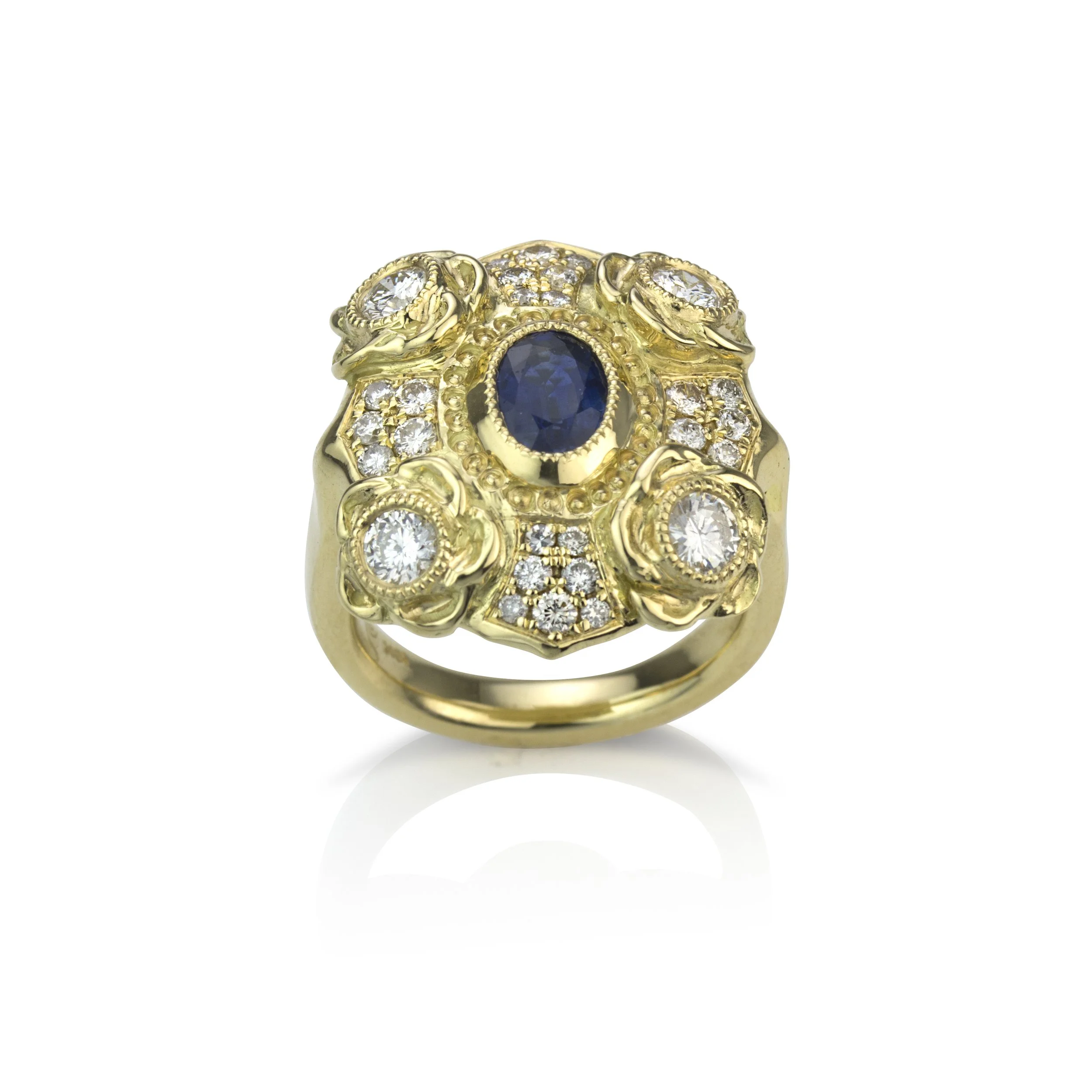
Custom Ring using Family Gold - Gillian Batcher
gold, sapphire, diamond
Gillian and her daughter at Jewel Envy
photo courtesy of Gillian Batcher
You have a comprehensive knowledge of what equipment or resource a jeweller may need. Your full-time artists have 24 hour access to a studio with an enviable list of equipment including thirteen benches, lapidary equipment, enamelling kilns, a lathe, a 3D printer, casting capabilities, and even a meeting room. Is there one piece of equipment that has kept you up at night? Something that you've been called down out of your residence above to fix?
Absolutely everything that can go wrong will go wrong the moment I try to leave the studio for a couple days. When I left for my honeymoon the gtech which converts the gas pressure for the torches went down, when I was trying to take two weeks off after my daughter was born the studio smoke alarms kept going off because of a new sprinkler system that was too sensitive, the website also goes down as soon as I am out of the city, and the list goes on. Lucky for me I have the best studio manager, Alexis Kostuk, who has had to trouble shoot everything when I am away. Over time I think I have created an environment where people feel empowered enough to know what is really an emergency and needs immediate action prompting a call outside of business hours to what can be left in a note or email for me to address when I am back in the shop. When I am out of town that responsibility shifts to the manager Alexis and she is afforded the same respect for calls outside of retail hours. Work life balance has not been my best skill, but I have tried to strive for more of it and understand that others deserve that right as well.
Is there anything you are working on acquiring?
We just got an XRF machine (which analyses jewellery to identify the elements present.) XRF has been on my list of equipment for a while. I buy equipment based on needs of the studio goldsmiths today and what I see as important for our future needs. We reuse customer provided gold so often that an accurate breakdown of metals in an alloy will make that material easier to reuse without needing to refine everything first.
My secondary list of equipment relates to having back-ups in preparation for failure. When possible, I like to purchase good second-hand equipment so that it can be used when something fails limiting studio downtime for the goldsmiths.
As a community builder, you have been a guide and a mentor. I know that in 2020 you led an effort to sponsor a family's migration journey to Canada. An inspiring accomplishment to say the least. It could be said that as jewellers and artists we may have a tendency to be myopic or to gaze inward. Is there anything that you wish the jewellery community in Canada could do better?
I wish the jewellery community would create and hold more jewellery specific events through calls for entry. I spent the first 10 years of my career applying to various shows and exhibitions and so many of those annual events are no longer around. I think you need to build the world you want, and as makers, we are highly equipped to do so but like you said we often have a hard time looking beyond their own work environment. Those calls for entry gave me purpose when I didn’t know what to make, opportunities to meet other goldsmiths, and exposure for my work to potential new clients. I didn’t have to do everything on my own and I think it’s a shame that new people in the field may feel an isolating pressure . I’m hopeful this will shift but more people must take on that role as business minded organizer for it to happen.
Gillian thank-you so much for sharing your thoughtful insights with us! Congratulations on this milestone in your amazing career.